॥ શ્રી સ્વામિનારાયણો વિજયતે ॥
VACHANAMRUT PARATHĀRO
3. Shri Hari’s Divine Exploits, Deeds, and Majesty
3. Shri Hari’s Divine Exploits, Deeds, and Majesty
Neelkanth Brahmachari came to the end of his journey as He reached Lojpur, a village near Mangrol Port on the sixth day of the dark half of the month of Shravan in S. Y. 1856.8 He had entered his nineteenth year. In this village Swami Ramanand, believed to be the incarnation of Uddhavji, had his ashram. Neelkanth met Swami Muktanand, the chief disciple of Ramanand. He could feel in Swami Muktanand the saintly attributes. He accepted Muktanand’s invitation to stay in the ashram.9 He stayed here for some months and then, on being informed of Ramanand’s arrival from Kutch, came to the village Piplana near Girnar with the sadhus of the ashram. Here He had the darshan of Shree Ramanand Swami in the house of a brahmin Narsinh Mehta on the twelfth day of the dark half of the month of Jyeshtha in S. Y. 1857.
Ramanand Swami was tall, fair in complexion and hefty. He had put on the dress of a celibate, an all-white dress. Neelkanth prostrated before him and sat near him. Ramanand Swami was pleased to meet Neelkanth. He enquired of Him, the place of His birth, His parents, etc. Neelkanth narrated in detail His birthplace, His parents, gotra, the Vedas of the family, pravar, guru and the deity He worshipped. He also explained how He was possessed by a sense of deep detachment and how He had left His house and renounced all worldly relations. He narrated the details of His travels in deep and dense forests, the severe tapas that He had performed and how He learnt ashtang-yoga. The story of his pilgrimage to various holy places, the various hypocrites in the garb of sadhus that he came across and how their hypocrisy was exposed was vividly described by Him.
Hearing this story, Ramanand Swami was pleased and patting Neelkanth said, “Oh Brahmachari! You are our kith and kin. Your father Dharmadev was initiated into Bhagwati Diksha by me at Prayagkshetra. While living in Koshal Desh, under my orders, he preached the tenets of Bhagwat Dharma to the aspirants and led them to the path of Krishna Bhakti. But I feel that you excel your father in the matter of virtues.” Neelkanth, hearing the words of the Swami, found the atmosphere congenial and hence he willingly stayed there with them.
On the eleventh day of the bright half of the month of Kartika in S. Y. 1857,10 Neelkanth was initiated in the Bhagwati Deeksha and was renamed ‘Sahajanand’. He was also given the other name, ‘Narayanmuni’. He then began to serve Ramanand Swami having become his Guru. Ramanand Swami also, realizing in Sahajanand all the virtues that a saint was expected to possess, handed over to him the responsibility of heading the Sampraday (the Satsang Fellowship), and on the thirteenth day of the bright half of the month of Margashirsha in S. Y. 1858, he passed away. He transmigrated to Badarikashram. Thus, he was freed from the curse of the sage Durvasa.
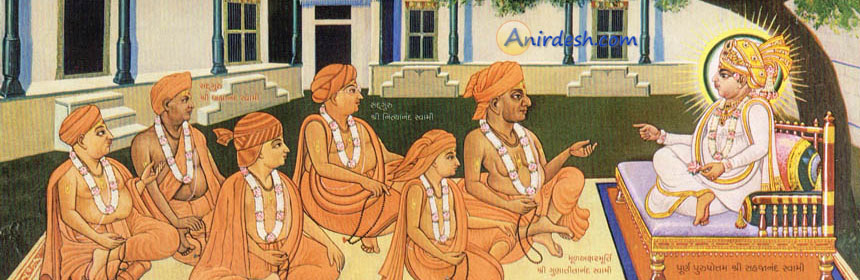
Sahajanand Swami performed the obsequies of his Guru. Heading the Sampraday, as willed by Ramanand Swami, He began to entertain the sadhus, brahmacharis and the laity who belonged to the Sampraday with words of wisdom from the scriptures. By his overflowing compassion and charming personality, he won them over.
Sahajanand Swami then along with his disciple sadhus, brahmacharis and the members of the laity toured the regions of Sorath, Halar, Kutch, Zalawad, Kathiawad,11 Bhal, Gujarat. Within a short time by His all-pervading divinity, He could uproot the evils that had corroded society and inculcated the tenets of dharma, gnan, vairagya, and bhakti in the hearts of the people. The spurious and evil-minded gurus were all humbled.
In all those regions which he toured, people became His disciples realizing His divine greatness. Shreeji Maharaj, in order to consolidate their faith in Him, sent them into a trance (samadhi). Some saw Shree Krishna with Laxmi and Radhika and with Shridama and other parshads in Akshardham in the midst of Golok, whereas some saw, during the state of samadhi, Shree Vishnu along with Lakshmi and the parshads Nand, Sunanda and others in the Vaikunth Lok. And some saw Mahapurush surrounded by the niranna-muktas in Shwetdweep. Some again saw Lakshmi and other divine powers surrounding Bhumapurush in the Avyakrut-dham.
Narnarayan gave their darshan in Badarikashram. And again some had the darshan of Yogeshwar lying on the Shesh serpent in Kshirsagar. Hiranyamay appeared before some in the solar region. In Agni-lok, Yagnapurush gave his darshan to some.
Some heard the divine sound pranav, whereas some saw the blinding light emanating as if from millions of suns. He appeared before some as Brahman – Sat-Chit-Anand – the drashta beyond the three states of waking, dream and deep sleep. Some had the darshan of Virat, the support of the universe, as described in the Purush-sukta.
Shreeji Maharaj, with a will to shower His grace in full abundance, showed them in trance the various abodes of gods and demi-gods in the cosmos. Some were thrilled to see the six Chakras and the presiding deities Ganesh and others of these Chakras.
At times He appeared before some in a divine form and accepted the food that was offered to His image. Sometimes, He gave His darshan to all irrespective of whether they had devotion to Him or not, and transmigrated the dying souls to His divine abode Akshardham. Overwhelmed by such divine grace, people used to behold Shree Sahajanandji Maharaj with great surprise and joined this Sampraday discarding their gurus and the cults they professed. Many pundits came to Him with a purpose to defeat Him in philosophical dialogues. However, realizing His great powers, they became humbled before Him and prayed to Him: “Oh Maharaj! You are God incarnate – the transcendental Highest. Kindly give us divine vision, so that we can see the deities whom we worship.” On hearing their request, He sent them into the state of samadhi. By merely having the darshan of Shreeji Maharaj, their prans were drawn towards Him, and becoming so inwardly drawn, they saw in the sate of samadhi Shreeji Maharaj in the form of the deities they were worshipping.
The Vaishanavas – the followers of the Vallabhkul – and also the followers of Madhva and Nimbark saw Shreeji Maharaj in the form of Shree Krishna surrounded by Gopis in Vrindavan sporting like a child. The followers of Ramanuj saw Him as Lakshminarayan along with the parshads, Nand, Sunand, Vishvaksen, Garud and others. The Ramanandis saw Him as Ramachandra seated on a divine throne with Sita, Lakshman and Hanumanji. The Sankarites saw Him as Jyoti and the Shaivites as Shivji with Parvati and Pramathgan. The devotees of the Sun God saw Him as Hiranyamay Purush in the solar region. The followers of Ganapati saw Him as Mahaganapati. The Jains as Tirthankar and the Muslims as Paigambar saw the all-pervading form of Shreeji Maharaj.
They could realize by the darshan they had in trance that Shreeji Maharaj was the cause of all avatars. Then they shed their other attachments and joined this Sampraday. Shreeji Maharaj by His divine power dispelled the darkness of ignorance and re-established the Ekantika Dharma, which had gone into total decadence on the earth.
He set up alms-houses with the wealth of his rich devotees and freely distributed food. Also He performed the Vishnu-yagas but prohibited the killing of animals for being offered as a sacrifice. He performed Atirudras also and served the Brahmins rich foods and gave monies by way of alms. He elevated their status by giving them due respect. The evil was wiped out.
Wherever He went, He laid great stress on the observance of the Varnashram Dharma, on the realization of one’s atma, on cultivating total detachment from the world and on knowing Him with His infinite glory and powers.
Shreeji Maharaj was the source of all blissful joy to His devotees always and at all times. He stayed mostly in Shree Gadhada pleased by the profound devotion of King Abhay and his son and daughters who had dedicated their all to His lotus feet. Here he celebrated Janmashtami, Ram-navmi, Prabodhini Ekadashi, Hutashani and Annakut festivals with great pomp. To these festivals the paramhansas, brahmacharis and devotees of different regions came and offered at the feet of Shreeji Maharaj rich clothes, ornaments, garlands and applied sandal paste to His forehead. Shreeji Maharaj also served them all rich foods and pleased the Brahmins and sadhus.
FOOTNOTES
8. Thursday, 21st August, 1799.
9. He asked him five questions regarding the forms of jiva, ishwar, maya, Brahman and Parabrahman, and receiving a very satisfactory reply from him, he consented to stay in the ashram.
10. Wednesday, 28th October, 1800.
11. The regions where the Kathis, a warrior tribe, lived.