
 Conic Sections
Rotation of Ellipses
In this example, we will rotate an ellipse. The formulas for the rotation of conics can be found on the page Rotation of Conics. This page goes in depth about rotating conics.
In this example, we will find the standard equation of an ellipse that has been rotated, we will find the center, the foci, and the length of the major and minor axes. Lastly, we will find the vertices. This example illustrates the process of completely finding all the critical values of the rotated conic itself.
Rotation Example
Problem: Rotate the ellipse \(-x^2+xy-2y^2+2x+3y-2 = 0\). Find its center and the foci.
Solution: Let’s find the angle of rotation first: \(\theta = \dfrac{1}{2}\cot^{-1}\dfrac{A-C}{B} = \dfrac{1}{2}\cot^{-1}\dfrac{-1-(-2)}{1} = 22.5^{\circ}\). The angle of rotation is positive.
Now, we will find the trigonometric values of the angle of rotation because they will be useful to find the vertices and the foci. Twice the angle of rotation is 45° and we know that sine and cosine are equal to \(\dfrac{\sqrt{2}}{2}\). Using the half-angle identities, \(\cos\theta = \dfrac{\sqrt{2+\sqrt{2}}}{2}\) and \(\sin\theta = \dfrac{\sqrt{2-\sqrt{2}}}{2}\).
We will use the formulas for the coefficients given in Rotation of Conics page to standardize the ellipse.
Because A > C and the angle of rotation is positive, we can use the short formulas to determine A' and C'.
(i) \(A' = \dfrac{-1+(-2)}{2} + \dfrac{1}{2}\sqrt{(-1-(-2))^2+1^2} = \dfrac{-3+\sqrt{2}}{2}\)
(ii) \(C' = \dfrac{-1+(-2)}{2} - \dfrac{1}{2}\sqrt{(-1-(-2))^2+1^2} = \dfrac{-3-\sqrt{2}}{2}\)
(iii) \(D' = 2\sqrt{\dfrac{1}{2}+\dfrac{|-1-(-2)|}{2\sqrt{(-1-(-2))^2+1^2}}} + \) \(3\sqrt{\dfrac{1}{2}-\dfrac{|(-1)-(-2)|}{2\sqrt{(-1-(-2))^2+1^2}}} = 2\sqrt{\dfrac{1}{2}+\dfrac{1}{2\sqrt{2}}} + \) \(3\sqrt{\dfrac{1}{2}-\dfrac{1}{2\sqrt{2}}} \).
Calculations for E' are similar:
(iii) \(E' = 3\sqrt{\dfrac{1}{2}+\dfrac{1}{2\sqrt{2}}} - \) \(2\sqrt{\dfrac{1}{2}-\dfrac{1}{2\sqrt{2}}} \).
We can simplify D' and E' a bit and come up with the following equation for the standardized ellipse.
The equation is: \(\left(-\dfrac{3}{2}+\dfrac{1}{\sqrt{2}}\right)x^2 + \left(-\dfrac{3}{2}-\dfrac{1}{\sqrt{2}}\right)y^2+\) \(\left(\sqrt{2+\sqrt{2}}+\dfrac{3}{2}\sqrt{2-\sqrt{2}}\right)x + \) \(\left(\dfrac{3}{2}\sqrt{2+\sqrt{2}}-\sqrt{2-\sqrt{2}}\right)y-2 = 0\).
Let’s multiply by –1 to make the leading coefficient positive.
The equation is: \(\left(\dfrac{3-\sqrt{2}}{2}\right)x^2 + \left(\dfrac{3+\sqrt{2}}{2}\right)y^2+\) \(-\left(\dfrac{1}{2}\sqrt{26+7\sqrt{2}}\right)x - \) \(\left(\dfrac{1}{2}\sqrt{26-7\sqrt{2}}\right)y+2 = 0\).
The Center of the Ellipse
To find the center of the original (slanted) ellipse, the easiest method may be to find the maximum and mininum by setting the derivative to 0. The derivative, when solved for y is \(\dfrac{dy}{dx} = \dfrac{1}{4}\left(\dfrac{-7x+11}{\pm\sqrt{-7x^2+22x-7}}+1\right)\). We will briefly solve this equation for 0. Let’s remove the 1/4 first because it does not contribute to the solution when set equal to 0.
(i) \(\pm\dfrac{-7x+11}{\sqrt{-7x^2+22x-7}} + 1 = 0 \)
(ii) \(-7x+11 \pm\sqrt{-7x^2+22x-7} = 0 \)
(iii) \( (-7x+11)^2 = (\pm\sqrt{-7x^2+22x-7})^2 \)
(iv) \( 49x^2-154x+121 = -7x^2+22x-7 \)
(vi) \( 7x^2-22x+16 = 0 \) (Rerrange and divide by 8)
(vii) \( x = \dfrac{22 \pm \sqrt{22^2-4(7)(16)}}{14} \)
(viii) \( x = \dfrac{22 \pm 6}{14} \)
The solutions to this equation are \(x = 2, \dfrac{8}{7}\).
Substituting x = 2 in the original ellipse equation to find y, we get y = 2, 1. We reject y = 1 because the maximum would be at (2,2) and (2,1) is just the other point on the ellipse.
Substituting x = 8/7, we get \(x=\dfrac{25}{14},\dfrac{2}{7}\). Since this point represents the minimum, we reject 25/14, the greater value, and our minimum is at (8/7, 2/7).
The midpoint of the points (2,2) and (8/7, 2/7) is our center. So, our center is at (11/7, 8/7).
Another method to find the center is to find the farthest horizontal points of the ellipse and find the midpoint. Solving the determinant for 0 will give us the farthest points because when the radical equals 0, there is only one point on the ellipse for that x value. The determinant is \((x+3)^2-8(x^2-2x+2)\) or \(7x^2-22x+7=0\). The solutions to this are \(\dfrac{11\pm 6\sqrt{2}}{7}\). Therefore, the x coordinate of the center of this ellipse is \(\dfrac{11}{7}\). To find the y values, we have to plug in the x, a feat in itself. Since we found the center already, we will skip this step.
The Foci
To find the foci and the eccentricity of the rotated conic, we need to find the value of c. To find that, we need to complete the squares. And that again is a feat. Nevertheless, we will use Wolfram to help us with the daunting radicals and really put the ellipse equation in standard form.
Remember that completion of squares of the expression \(Ax^2 + Dx + Cy^2 + Ey\) is \(A\left(x+\dfrac{D}{2A}\right)^2 + C\left(y-\dfrac{E}{2C}\right)^2 - \dfrac{D^2}{4A} - \dfrac{E^2}{4C} \).
(i) \(\dfrac{3-\sqrt{2}}{2}\left(x - \dfrac{\sqrt{370+233\sqrt{2}}}{14}\right)^2 - \dfrac{92+47\sqrt{2}}{56}+\) \(\dfrac{3+\sqrt{2}}{2}\left(y - \dfrac{\sqrt{370-233\sqrt{2}}}{14}\right)^2 - \dfrac{92-47\sqrt{2}}{56} + 2 = 0\)
(ii) \(\dfrac{3-\sqrt{2}}{2}\left(x - \dfrac{\sqrt{370+233\sqrt{2}}}{14}\right)^2 + \) \(\dfrac{3+\sqrt{2}}{2}\left(y - \dfrac{\sqrt{370-233\sqrt{2}}}{14}\right)^2 = \dfrac{9}{7}\)
(iii) \(\dfrac{\left(x - \dfrac{\sqrt{370+233\sqrt{2}}}{14}\right)^2}{\dfrac{54+18\sqrt{2}}{49}} + \) \(\dfrac{\left(y - \dfrac{\sqrt{370-233\sqrt{2}}}{14}\right)^2}{\dfrac{54-18\sqrt{2}}{49}} = 1\)
That puts our ellipse equation in the real standard form.
The foci distance is \(c^2 = a^2 - b^2 = \dfrac{54+18\sqrt{2}}{49} - \dfrac{54-18\sqrt{2}}{49} = \dfrac{36\sqrt{2}}{49}\) and \(c = \dfrac{6}{7}\sqrt[4]{2}\).
The eccentricity of this ellipse is \(e = \dfrac{c}{a} = \dfrac{\dfrac{6}{7}\sqrt[4]{2}}{\dfrac{\sqrt{54+18\sqrt{2}}}{7}} = \sqrt{\dfrac{2}{7}(3\sqrt{2}-2)} \approx 0.8005\). The image below shows all the critical points of our ellipse.
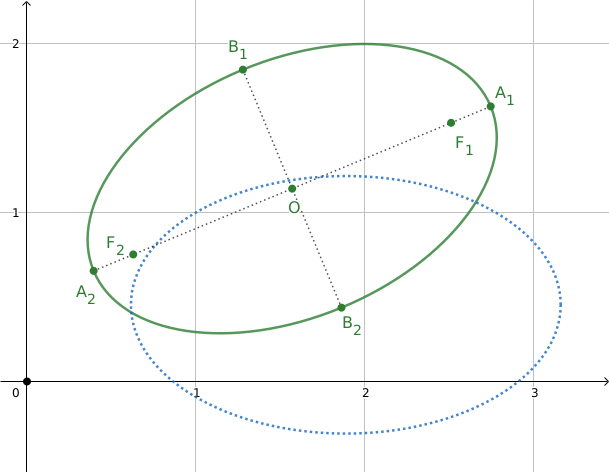
To find the foci, we need to find the x and y displacements. For that, we need the sine and cosine of our rotation angle, which we found earlier. The displacements are the trigonometric values multiplied by the focal distance, c. Therefore, the displacements are \(\Delta x = \dfrac{6}{7}\sqrt{\sqrt{2}}\cdot \dfrac{1}{2}\sqrt{2+\sqrt{2}} = \dfrac{3}{7}\sqrt{2\sqrt{2}+2}\) and \(\Delta y = \dfrac{6}{7}\sqrt{\sqrt{2}}\cdot \dfrac{1}{2}\sqrt{2-\sqrt{2}} = \dfrac{3}{7}\sqrt{2\sqrt{2}-2}\).
This places our foci at \(\left( \dfrac{11}{7} \pm \dfrac{3}{7}\sqrt{2\sqrt{2}+2}, \dfrac{8}{7} \pm \dfrac{3}{7}\sqrt{2\sqrt{2}-2} \right)\).
The Major Vertices
The farthest vertices are the ones on the major axis. The length of the major axis is 2a. To find the coordinates of these vertices, we simply apply the trigonometric values to the length a. The x-coordinate is:
(i) \(\Delta x = a\cos\theta = \left( \dfrac{\sqrt{54+18\sqrt{2}}}{7}\right)\left( \dfrac{\sqrt{2+\sqrt{2}}}{2} \right) = \dfrac{3}{14}\sqrt{16+10\sqrt{2}}\)
(ii) \(\Delta y = a\sin\theta = \left( \dfrac{\sqrt{54+18\sqrt{2}}}{7}\right)\left( \dfrac{\sqrt{2-\sqrt{2}}}{2} \right) = \dfrac{3}{14}\sqrt{8-2\sqrt{2}}\)
We add both these displacements to the center to find one foci and subtract from the center to find the second foci. Therefore, our fartest vertices - “major vertices” - are located at \( \left( \dfrac{11}{7} \pm \dfrac{3}{14}\sqrt{16+10\sqrt{2}}, \dfrac{8}{7} \pm \dfrac{3}{14}\sqrt{8-2\sqrt{2}} \right) \).
The major vertices were similar to the foci because the foci lie on the major axis. The only difference was the hypotenuse involved.
The Minor Vertices
The minor vertices are a bit different because the displacement triangle is essentially upside down. Therefore, the sine and cosine values are switched for the x and y displacements.
For the minor vertices, we use the b value.
(i) \(\Delta x = b\sin\theta = \left( \dfrac{\sqrt{54-18\sqrt{2}}}{7}\right)\left( \dfrac{\sqrt{2-\sqrt{2}}}{2} \right) = \dfrac{3}{14}\sqrt{16-10\sqrt{2}}\)
(ii) \(\Delta y = b\cos\theta = \left( \dfrac{\sqrt{54-18\sqrt{2}}}{7}\right)\left( \dfrac{\sqrt{2+\sqrt{2}}}{2} \right) = \dfrac{3}{14}\sqrt{8+2\sqrt{2}}\)
We add or subtract both these displacements to the center to find one foci and subtract from the center to find the second foci. Therefore, our closest vertices - “minor vertices” - are located at \( \left( \dfrac{11}{7} \pm \dfrac{3}{14}\sqrt{16-10\sqrt{2}}, \dfrac{8}{7} \mp \dfrac{3}{14}\sqrt{8+2\sqrt{2}} \right) \).
Note the opposite signs for the minor vertices because of their relative location to the center.
Looking Back
Of all the values we calculated, only the center of the rotated ellipse came out to be nice rational numbers. The rest were complicated irrational numbers. Even when put in standard form, the foci, major and minor axes and the center were irrational.
Although I have not put a general ellipse equation in standard form to find its center, I believe the center will always be a rational number if the coefficients of the ellipse are rational numbers. The rest will be irrational. If there are some irrational coefficients, then the major and minor axes may turn out to be rational.
For parabola, this was also the case. The vertex and the focus of the parabola were always rational coordinates when the coefficients were rational.
We can simply apply reasoning for this. The center is the midpoint of the maximum and minimum of the ellipse. When we solve the derivative for 0, we will get a quadratic equation whose solutions will be of the form: \(x = a \pm \sqrt{b} \). When these points are averaged, the root part will cancel out and leave only the rational part for the x coordinate. The same goes for the y value.